
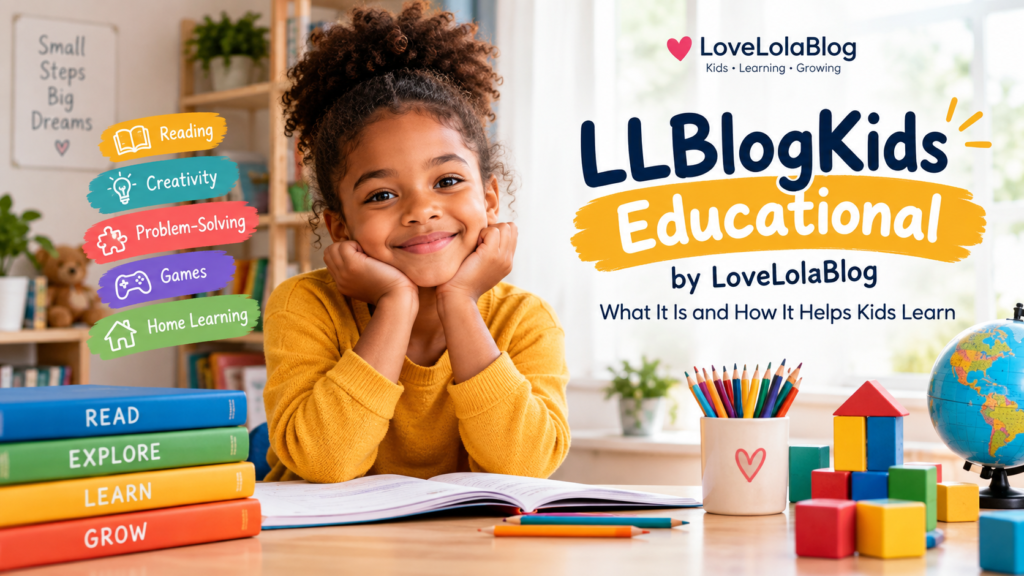
LLBlogKids educational by LoveLolaBlog is an education-focused topic built around practical ways children can learn through activities, reading, creativity, problem-solving, educational games, and home learning. The goal is to make learning more engaging while helping parents support skills that children can use both inside and outside the classroom.
LoveLolaBlog’s own description of its LLBlogKids educational section highlights learning activities, reading habits, creative thinking, problem-solving, educational games, school success, and home learning. That makes the topic broader than traditional homework. It is about creating useful opportunities for children to explore ideas, practice skills, and learn through everyday experiences.
What Is LLBlogKids Educational by LoveLolaBlog?
LLBlogKids educational by LoveLolaBlog refers to children’s educational content focused on making learning practical, accessible, and engaging.
The subject covers several connected areas:
- Learning activities for children
- Reading and literacy habits
- Creative thinking
- Problem-solving
- Educational games
- School-related learning
- Home learning
The important point is that these areas do not have to be taught separately. A single activity can involve several skills at once.
For example, a child reading a short story can practice vocabulary and comprehension. Asking what might happen next can encourage reasoning. Creating a different ending can add creativity and writing practice.
That kind of connected learning is what makes the LLBlogKids educational topic useful for parents looking for ideas beyond conventional worksheets.
What Can Children Learn Through LLBlogKids Educational Activities?
Children can use well-designed activities to practice reading, communication, mathematics, observation, creativity, reasoning, and problem-solving. The specific skills depend on the activity and the child’s age.
A useful activity does not necessarily need to look like a school lesson. Counting objects around the house can introduce mathematics. Describing something found outside can encourage observation. Building with blocks can involve planning and spatial thinking.
Here is a simple way to connect common activities with the skills they can develop:
| Activity | Skills children can practice |
|---|---|
| Reading a story | Vocabulary, comprehension, communication |
| Counting household objects | Number skills, comparison, reasoning |
| Building with blocks | Planning, spatial thinking, problem-solving |
| Creating a story | Imagination, sequencing, language |
| Nature observation | Curiosity, observation, questioning |
| Simple cooking | Measurement, sequencing, following instructions |
| Educational games | Memory, attention, strategy, decision-making |
The value comes from active participation. Instead of simply giving a child information, parents can encourage the child to explain, predict, compare, create, or solve something.
Why Learning Through Play Matters
Play can be an important part of children’s learning because it gives them opportunities to practice skills while actively participating.
Harvard’s Center on the Developing Child explains that playful activities can help children practice executive-function skills such as attention, working memory, and self-control. Its resources also provide different activities for different stages of childhood.
Harvard Center on the Developing Child: Brain-Building Through Play
This does not mean every game is automatically educational. The learning value depends on what the child is doing.
A puzzle can require planning. A matching game can involve memory. Pretend play can encourage communication and imagination. A building challenge can require a child to test an idea and change the plan when it does not work.
For parents using LLBlogKids educational ideas at home, the useful question is therefore not simply, “Is this a game?”
A better question is:
What is the child practicing while playing?
Reading Can Turn Into an Active Learning Experience
Reading is another important part of the LLBlogKids educational approach because a book can become much more than a quiet activity.
Parents can ask children to predict what will happen next, explain why a character behaved a certain way, describe a picture, or retell part of the story in their own words.
For younger children, simply talking about pictures and naming objects can create opportunities for language development. For older children, questions about characters, events, evidence, and alternative endings can make reading more interactive.
The key is to keep the conversation natural. Reading should not always feel like a test.
A five-minute discussion about a story can sometimes be more useful than asking a child to complete a long list of questions.
Practical LLBlogKids Educational Activities to Try at Home
The strongest activities are often simple enough to begin without special equipment.
1. Build a Story Together
Choose a picture, toy, animal, or everyday object and ask the child to create a story around it.
You can start with one sentence and let the child add the next part. Older children can write the story instead of telling it.
This can combine vocabulary, sequencing, imagination, and communication.
2. Turn Everyday Objects Into Math
Use toys, pencils, spoons, books, or other safe household objects.
Ask questions such as:
- How many are there?
- Which group has more?
- Can you arrange them from smallest to largest?
- What happens if we add two more?
- How many would remain if we removed three?
The activity changes naturally with age. A younger child can practice counting, while an older child can work with multiplication, fractions, measurement, or practical calculations.
3. Create a Nature Question
During a walk or time outdoors, choose something interesting and ask the child to observe it closely.
It could be a plant, insect, cloud, leaf, or bird.
Instead of immediately providing all the answers, ask what the child notices and what they want to know.
This turns curiosity into the starting point for exploration.
4. Learn Through Cooking
Cooking can combine several practical skills.
Children can count ingredients, measure quantities, follow a sequence of instructions, compare sizes, and observe how ingredients change.
Parents should naturally handle tasks involving heat, sharp objects, or other hazards. The educational part can still involve the child without requiring them to handle unsafe equipment.
5. Create a Small Problem to Solve
Give the child an age-appropriate challenge.
For example:
“We have these blocks and need to build something that can hold this toy. How could we do it?”
There does not need to be only one correct solution.
The child can try an idea, see what happens, and adjust it. That process is useful because problem-solving often involves testing rather than immediately knowing the answer.
How to Adapt LLBlogKids Educational Activities by Age
Educational activities should become more appropriate to a child’s abilities as the child develops. A three-year-old and a ten-year-old can explore the same broad subject, but they should not necessarily receive the same task.
Younger Children
Keep activities short, concrete, and interactive.
Useful ideas include:
- Picture books
- Sorting objects
- Simple counting
- Matching games
- Drawing
- Songs and rhymes
- Basic storytelling
The parent may need to participate more actively.
Early School Years
Activities can become more structured.
Children can:
- Read short books independently
- Solve simple puzzles
- Write short stories
- Conduct basic observations
- Practice arithmetic through everyday tasks
- Explain how they reached an answer
Older Children
Give children more independence and open-ended challenges.
They might research a question, plan a small project, compare different solutions, create a presentation, or develop their own story or experiment.
Harvard’s play resources similarly organize activities across different stages, including activities for children aged 4 to 7 and 8 to 12.
The principle is simple: increase the complexity without removing the opportunity to explore.
How Technology Fits Into Educational Learning
Technology can be useful for children’s education, but calling something “educational” does not automatically make it a good learning experience.
The American Academy of Pediatrics emphasizes looking at the quality and context of digital media rather than treating the number of minutes as the only consideration. Its recent guidance also notes that well-designed educational digital media can support areas such as mathematics and reading, while lower-quality or excessive use can crowd out other important activities.
American Academy of Pediatrics: Digital Media Guidance
Parents can therefore ask:
- Does the activity have a clear learning purpose?
- Is the content appropriate for the child’s age?
- Does the child actively participate?
- Does it encourage thinking or creativity?
- Is a parent able to participate when appropriate?
- Is digital use crowding out reading, physical activity, sleep, conversation, or play?
Technology can support an educational routine, but it does not need to replace hands-on activities or human interaction.
What Makes Educational Content Useful for Children?
Good children’s educational content should be understandable, age-appropriate, purposeful, and engaging.
It should give children something meaningful to do, not merely something to consume.
For parents evaluating an activity, five questions can help:
Does it have a purpose?
The activity should develop or practice something.
Is it appropriate for the child’s ability?
A task should be challenging without being unnecessarily frustrating.
Does the child participate?
Children should have opportunities to make choices, answer questions, create things, or solve problems.
Does it encourage curiosity?
A strong activity can lead to another question rather than ending the moment the answer is found.
Can it fit into real life?
The best home-learning ideas do not always require elaborate preparation.
These principles fit naturally with the areas LoveLolaBlog identifies for LLBlogKids educational, including reading, creative thinking, problem-solving, educational games, and home learning.
Is LLBlogKids Educational a Website or a Learning Program?
LLBlogKids educational by LoveLolaBlog is best understood from the available LoveLolaBlog material as an educational content area focused on children’s learning, rather than assuming it is a formally accredited school or standalone academic program.
LoveLolaBlog identifies the topic through areas such as learning activities, reading habits, creative thinking, problem-solving, educational games, school success, and home learning.
That distinction matters because parents should not assume that a blog-based educational resource replaces a child’s school curriculum, teacher, or individualized professional support.
Instead, its ideas can be viewed as supplementary activities that help make learning more engaging at home.
Frequently Asked Questions
What is llblogkids educational by lovelolablog?
LLBlogKids educational by LoveLolaBlog is an education-focused content area centered on children’s learning activities, reading, creative thinking, problem-solving, educational games, school success, and home learning.
What can children learn from LLBlogKids educational activities?
Children can practice skills such as reading, communication, counting, observation, creativity, reasoning, memory, and problem-solving, depending on the activity and their age.
Are LLBlogKids educational activities only for school subjects?
No. Learning activities can also support creativity, communication, curiosity, practical skills, and problem-solving. These abilities can complement formal school learning.
Do children need worksheets to learn effectively?
No. Worksheets are only one possible learning format. Reading, games, storytelling, building, cooking, observation, and everyday conversations can also provide meaningful practice.
Can technology be part of LLBlogKids educational learning?
Yes, digital resources can be part of children’s learning when the content is appropriate and meaningful. Parents should also consider what digital use replaces, including reading, physical activity, sleep, conversation, and play.
How can parents make home learning more enjoyable?
Keep activities appropriate to the child’s ability, give children opportunities to participate, connect learning with their interests, and allow room for questions and experimentation. Short, consistent activities can be easier to maintain than long sessions.
Final Takeaway
LLBlogKids educational by LoveLolaBlog is centered on making children’s learning more practical, active, and engaging. Its documented focus includes learning activities, reading habits, creative thinking, problem-solving, educational games, school success, and home learning.
For parents, the most useful way to apply these ideas is to look for ordinary opportunities to learn. A story can become a conversation about language. A group of toys can become a mathematics activity. A walk can become a science investigation. A cooking task can introduce measurement and sequencing.
The aim is not to turn every moment at home into a lesson. It is to create learning experiences that give children opportunities to read, think, ask questions, create, solve problems, and explore.
That is where the practical value of LLBlogKids educational by LoveLolaBlog becomes clear: learning does not have to be complicated to be meaningful.