
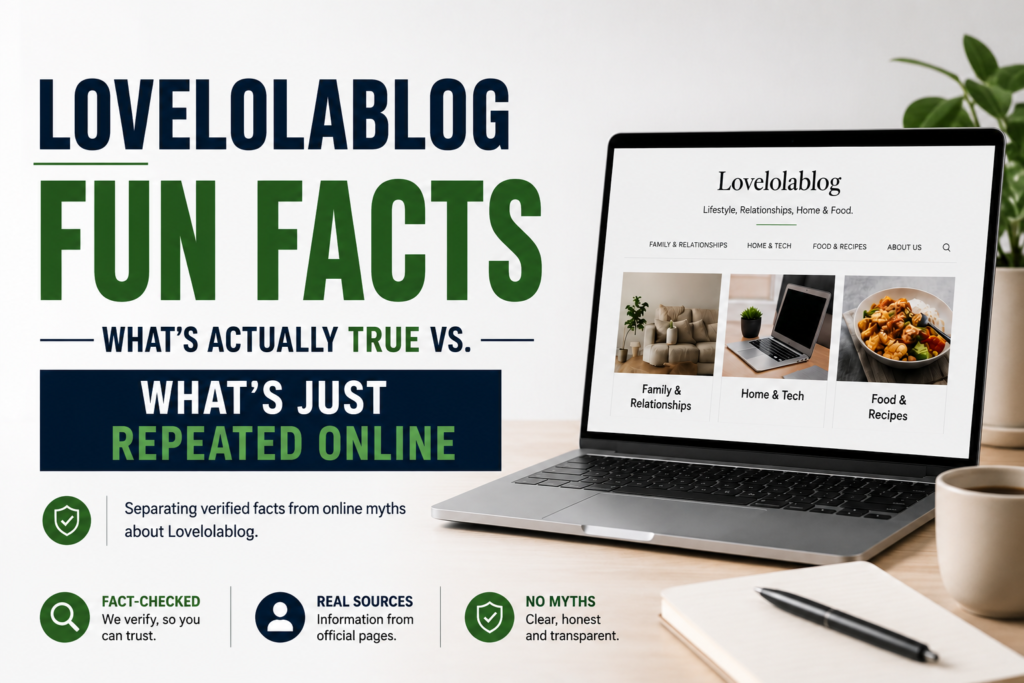
Quick answer: Lovelolablog is a real, small lifestyle blog. It covers family relationships, home and tech, and food. Most of the specific “fun facts” about it online don’t hold up under a basic check. Many even contradict each other. Right now, only two sources back up any claim about this blog: its own About page and its public Facebook page.
Search “lovelolablog fun facts” and you’ll land on a dozen articles that disagree with each other. Some claim the blog started as a personal diary about a dog named Lola. Others call it a “lifestyle media network” with over 100,000 monthly readers. The real, official Lovelolablog site says neither. This article sorts the verifiable claims from the repeated ones. It also shows you exactly how to check the difference yourself.
Key Takeaways
- Lovelolablog is a real, active blog. Its own official About page confirms this.
- The blog’s team bios name three writers by role. None mention a founder or a dog-related origin story.
- No independent source backs up claims of “100,000+ monthly readers” or a “media network” structure.
- The blog’s public Facebook page shows a small following. Its last dated post goes back to 2020.
- Low-competition, brand-style keywords like this one attract content farms. They’re easy to rank for, and once one site publishes a claim, others often copy it without checking the original.
What People Actually Mean by “Lovelolablog Fun Facts”
The phrase points to a small lifestyle blog called Lovelolablog. But the search term has taken on a life of its own online. Dozens of websites now publish “fun facts” articles about this blog. Many describe it in ways that don’t match the blog’s own pages. You can’t trace those claims back to any original source. Before you repeat any of them, it helps to know which ones you can actually check.
Popular Claims at a Glance
| Claim | What Some Sites Say | Verified Status | What’s Actually Known |
|---|---|---|---|
| Origin story | Started as a diary after adopting a dog named Lola | Unverified | The blog’s own About page names a three-person team and skips any dog origin story |
| Reader numbers | Over 100,000 monthly readers | Unverified | No public analytics, press coverage, or third-party traffic estimate supports this number |
| Site structure | A “lifestyle media network” with formal budget tiers | Unverified | The official site looks like a standard single blog, not a multi-brand network |
| Fact verification | Checks every fact against sources like NASA and National Geographic | Unverified | The official site names no editorial or fact-checking policy at all |
| Team | A small named team covers specific topics | Verified | The blog’s own About page confirms this directly |
| Social presence | An active, large community | Partially verified | The public Facebook page shows a modest following and a last dated post from 2020 |
The Claims You’ll Find Online, and Why They Don’t Agree
Read enough of these articles and a pattern shows up fast. The more specific a claim gets, the less likely it holds up against another source.
Conflicting Origin Stories
One widely shared version says the blog began as a personal journaling project. It claims the founder started writing after adopting a dog named Lola. That version says the name reflects “love for learning, laughter, and life.” The blog’s own current About page tells a different story. It names three team members and gives each one a topic area: family relationships, home and tech, and food. It never mentions a dog. Neither version cites the other. No source outside the blogging content itself backs up either story.
Conflicting Scale Claims
Several articles describe Lovelolablog as pulling in “over 100,000 readers monthly.” Some go further and call it a “lifestyle media network” with formal budget tiers for home projects. The blog’s Facebook page tells a different story. Its most recent dated post goes back to 2020. The page has a few hundred likes. That points to a small, largely dormant social presence, not a high-traffic media operation. No public analytics, press mention, or third-party estimate supports the larger numbers.
This kind of inconsistency shows up often enough that Google addresses it directly. Its guidance tells readers to check for more than one independent source before they treat a claim as established. The Google Search Central documentation on E-E-A-T makes a similar point for publishers. Show real experience and trustworthiness. Don’t just repeat what already ranks.
What’s Actually Verifiable
Strip away the competing narratives, and a smaller, more grounded picture remains.
What the Official Site Says About Itself
Lovelolablog’s own About page describes a lifestyle blog. It covers family relationships, home and tech, and food, written by a small named team, never claims a specific founding story involving a pet, and never calls itself a media network. This is a self-reported claim, so treat it as the blog’s own account rather than confirmed history. Still, you can trace it to the source itself instead of to a third-party article about the source.
What Independently Checkable Data Shows
Anyone can view the blog’s Facebook page. It shows a modest following, and its last substantive post goes back several years. That’s directly checkable. It points toward a small, personal-style blog rather than a large publishing operation. A claim you can check against public, independent data deserves more weight than one that only shows up on other “fun facts” articles with no source link.
How This Was Verified
Here’s exactly what we checked before writing this article. First, the official Lovelolablog website and its About page. Second, the blog’s public Facebook page and its post history. Third, more than a dozen third-party “fun facts” articles about the blog. We compared their claims against each other and against the two sources above. If a claim showed up only in third-party articles, with no link to an original source, we labeled it unverified here instead of calling it fact.
Why So Many “Fun Facts” Pages Exist for One Small Blog
This pattern isn’t unique to Lovelolablog. Content sites target low-competition, brand-name, “fun facts” style keywords for a simple reason. They’re cheap to write for and easy to rank on. AI writing tools make this even easier. They can generate a plausible-sounding article without ever visiting the subject’s actual website. Once a few articles publish a specific claim, later articles often repeat it without checking the original. A made-up detail can end up looking well established just because it shows up in several places at once. A round, impressive number like “100,000 readers” also spreads faster than a modest, accurate one, even with no evidence behind it.
How to Spot This Pattern on Any Search Term
Use these same checks whether you’re researching a blog, a small business, or a public figure.
- Start with the official source. Read the subject’s own About page or official social accounts first. Do this before you read what other sites say about them.
- Compare independent sources. If a claim only shows up on similar-looking content sites with no original source, treat it as unverified.
- Check the dates. A detail from 2020 may not describe a website in its current form anymore.
- Separate facts from opinions. A claim about “team size” or “monthly readers” needs evidence. A claim about tone or personality doesn’t.
- Watch for round, impressive numbers. Figures like “100,000 readers” or “verified by NASA” with no source or link are a common sign of unverified filler content.
- Check who’s repeating the claim. Ten articles saying the same thing, all in the same template, is evidence of copying. It isn’t confirmation.
Media literacy organizations recommend a similar process for evaluating any viral claim online. The News Literacy Project’s guidance on verifying information walks through comparable steps for checking a source. The same logic applies just as well to a small blog as it does to breaking news.
Frequently Asked Questions
Is Lovelolablog a real blog?
Yes. Lovelolablog’s own official About page confirms it as a real, active lifestyle blog. It covers topics such as family relationships, home and tech, and food.
Why do fun facts about Lovelolablog conflict across websites?
Many articles using this search term skipped the blog’s own pages entirely. Some appear to have invented or copied details. Later articles repeated those details without checking them. That’s why the origin story, team details, and traffic numbers vary so much from site to site.
Is Lovelolablog a large media network with thousands of readers?
No independently checkable data backs up that claim. The blog’s public social media presence points to a small, modest-sized audience. Its exact current traffic isn’t publicly disclosed.
Did Lovelolablog start because of a dog named Lola?
Some third-party sites tell that story. The blog’s own current About page never mentions it, and no independent source confirms it. Treat it as unverified rather than established history.
Does Lovelolablog fact-check its content against sources like NASA?
The official site names no such policy. That claim currently appears to come from a third-party article rather than from Lovelolablog itself.
How can I check if a fact about a blog or website is true?
Start with the site’s own official pages. Compare multiple independent sources. Check how recent the information is. Stay cautious of specific numbers or stories with no source attached.
Should I trust “fun facts” articles about small blogs in general?
Treat them as a starting point, not a final answer. Cross-check any specific claim against the subject’s own official pages before you repeat it, especially numbers or origin stories.